One Thing You Need to Know About Baby Skincare Products!

There are so many different skincare products for babies out there. It can be overwhelming to know what's best for bub!
You'll often see brands advertised as "low tox" and "no nasties" which of course, sounds like the better option. Less chemical is surely better for your baby?
Firstly, this isn't necessarily true. Everything is a "chemical" and having "chemicals" or long wordy ingredients list doesn't mean it is harmful or an inferior product. It also doesn't mean that the more "natural" products aren't good either. We just want parents to be mindful of marketing buzz words that try to make you think a product is better (especially when these types of products can be more expensive too!).
As much as we would love to, we aren't going to sit here and write a list of "best" and "worst" products. There are a few reasons for this:
- Product ingredients can change, so if we did publish a list we would have to constantly review and add to it.
- What is ideal for one baby's skin may not be for another.
- It is outside our scope to recommend specific skincare products. Anyone in the nutrition field that is recommending skincare products/brands to you needs to think about if they have the skills and expertise to do so.
- Registered healthcare professionals are strictly regulated when it comes to recommending and promoting "therapeutic goods" which means that we can't actually promote most products.
- It moralises the product as being "good" and "bad"- therefore can make parents feel like they are "good" or "bad" because of the product choice they make. None of these products are good or bad- they are just different from each other. Some are going to be a much better choice for YOUR family. Who are we to tell you what is best?
So, if we can't recommend products, why are we even talking about skincare? Well this is because there is ONE thing every parents of a baby should know.
We shouldn't be using skincare products with food ingredients on babies skin.
Now, we usually don't say "shouldn't" and instead try to educate and empower parents to make decision that fit best for the needs of their own family....
BUT we now know that introducing food proteins through the skin before they have been introduced orally may increase the risk of food allergy. ESPECIALLY for babies with eczema. As the food allergy capital of the world this is something all parents need to know.
This is why we are talking about skincare today! Yes, we are about all things starting solids and feeding your family, but we also provide a lot of information about introducing allergens to reduce allergy risk. So it makes sense, that we tell you about something else that might increase food allergy risk.
Research tells us that babies who have food allergens like nuts, eggs and milk introduced through skin care products are more likely to develop food allergies. This is especially true for babies with eczema where the inflamed skin barrier is weakened.
This includes:
- moisturisers
- baby massage oil
- Sunscreens
- Nappy rash creams
- Treatment for cradle cap
Now, we encourage you to read labels carefully! Although you might not suspect your sunscreen or nappy rash cream to contain a food ingredient research has shown that nearly 40% of products marketed to kids contain at least one common food allergen(1).
This advice isn't just limited to children either. We also have research that adults which eczema that use skin products that contain peanut, oats, wheat and goats milk are more likely to develop food allergy too, even if they have tolerated that food in their diet!
Why?
The working theory is that putting food ingredients on the skin may sensitise that person to the food through the skin and not the gut, which is how it is meant to be introduced to the body. For people with eczema, that skin barrier is broken and the food protein is more likely to get into the body and interact with the immune system. There is more evidence emerging that children with eczema are more likely to develop food allergy through skin exposure. One study of 512 infants found exposure to microscopic amounts of peanut through broken skin (eczema) increased risk of food allergy(2).
It is often the parents of little one's with eczema that are desperate to find something to soothe their child's skin. They are likely to spend more money, try more products and use "natural" products to support their kids skin. Unfortunately these are the same kids that are most at risk of food allergy if skin care products have food ingredients in them.
The most up to date and evidenced based advice in Australia comes from ASCIA (the Australasian Society of Clinical Immunology and Allergy) and they state that "anyone with eczema is to 'apply moisturiser at least twice a day, avoiding those that contain food products'. All people, especially those with eczema, should use skincare products that DO NOT contain food protein." Now this is whether or not it has been introduced and tolerated through the diet.
What do we advise?
Baby Led Weaning (BLW) and Allergen Introduction
You can check out our article on combo feeding here. We don't promote one particular way of starting solids as being better than any other. There are pros and cons to both (and mess with both regardless!). However, when it comes to allergen introduction we want to chat about BLW especially for babies with eczema.
Baby led weaning gives your bub the chance to pick up food and get really messy. Mess can be great! It can teach them about the sensory properties of the food and help them learn. But, it also offers the opportunity for exposure to those common allergens via the skin and not through the gut. We have already flagged that especially for eczema bubs skin exposure can increase allergy risk.
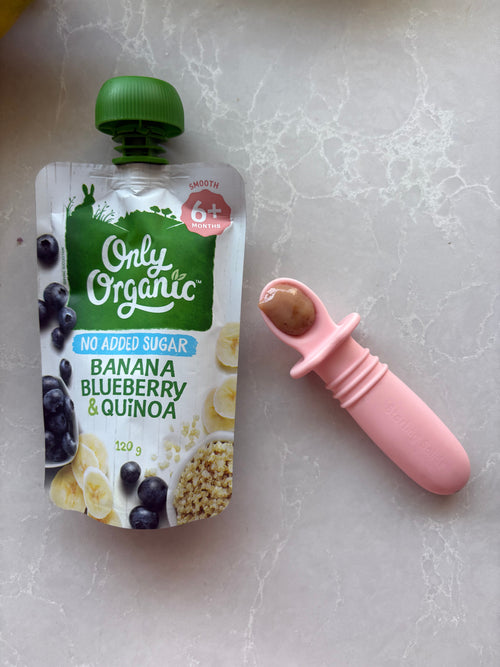
For his reason, we recommend that when introducing common allergens, you do it in a way that ensure they are actually ingesting the food and not just squishing it between their fingers and all over they face. Spoon feeding a small amount of the allergen to your bub, even if you are doing BLW, means they are actually ingesting the allergen and we are reducing that skin contact too.
What to do and who to talk to about skin care and allergens
- If you're concerned, talk to someone who is qualified to advise you on the best products to use.
- If your little one has eczema be VERY cautious about putting anything on their skin that contains food ingredients. Even if you have introduced it to them orally and it is tolerated in their diet, be cautious about using food ingredients on their skin at all. Always follow the advice given to you by your health care team.
- GP, dermatologist, dermatologist nurse practitioner- these all good people to talk to about the right products for you little one and best eczema management.
References:
- https://allergyfacts.org.au/news-alerts/allergy-matters-blog/development-of-food-allergy-through-food-based-skincare-products
- https://www.jacionline.org/article/S0091-6749(14)01476-6/fulltext
Other Resources:
https://www.abc.net.au/everyday/avoid-skincare-with-food-ingredients-child-eczema/100040570
https://preventallergies.org.au/eczema/eczema-and-food-allergy-prevention/
https://www.ncbi.nlm.nih.gov/pmc/articles/PMC10016742/
https://onlinelibrary.wiley.com/doi/abs/10.1111/cea.12992
https://pubmed.ncbi.nlm.nih.gov/32588439/
https://www.allergy.org.au/hp/papers/infant-feeding-and-allergy-prevention
Consultations
Choose one of our professional services that best suits your needs > Book Now about Consultations
🔒 This is Starting Solids Library content
Unlock every recipe, resource, review & ebook — plus the Crash Course, live monthly workshops, and our members forum.
$25/month unlocks $125+ in value
Unlock Premium AccessAlready a member? Log in