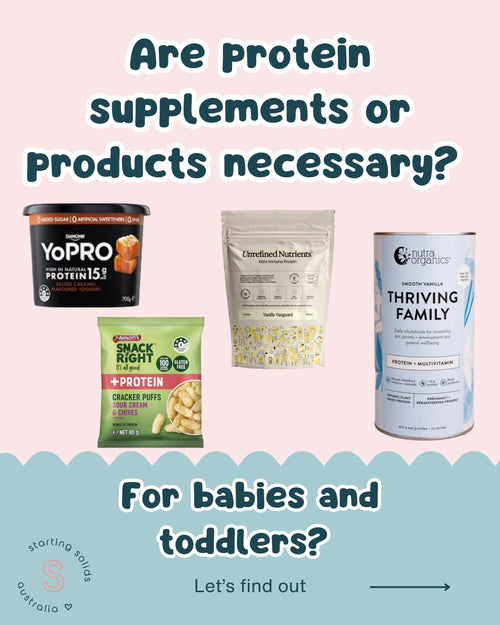
Do Babies & Kids Need Supplements, Protein or Veggie Powders?

Most kids already get plenty of protein
One of the biggest marketing pushes right now is protein. But most Australian children are already comfortably meeting their protein needs through everyday food - and by a wide margin.
The recommended dietary intake for protein is around 14g a day for a 1-3 year old.(1) To put that in perspective: a small tub of yoghurt, an egg and a few cubes of cheese will get you there. National survey data shows Australian toddlers and children typically consume well above their protein requirements.(2)
Protein deficiency in a healthy Australian child eating a normal diet is genuinely rare. So no - there's usually no need for a protein powder or protein supplement.
Instead, focus on including protein-rich foods across the day:
- Meat, chicken and fish
- Eggs
- Dairy foods like yoghurt, cheese and milk
- Legumes like lentils, chickpeas and beans
- Nuts and seeds (age-appropriate and safely served)
- Tofu and other soy foods
Even for children who don't eat meat, protein needs can absolutely be met through a well-balanced diet.(3) And yes - hemp seeds are a great option too, with an impressive protein content.
Most veggie powders contain very little actual vegetable
Many veggie powders sound impressive, but look closely at the label and the actual serve size is often tiny - a few grams. They're also heavily processed, and processing steps like heating and drying can reduce heat- and light-sensitive nutrients such as vitamin C and folate.(4)
Which means the powder is rarely doing what the packaging implies it's doing.
What does a veggie powder actually teach?
This is the bit that gets missed, and it's the big one. If a child drinks a vegetable powder mixed into a smoothie or water, they aren't learning a single thing about the actual food.
They're not seeing:
- What broccoli looks like
- How carrots smell
- What capsicum tastes like
- How different vegetables feel and change when cooked
Food acceptance comes through exposure. The research here is consistent: children need repeated, low-pressure exposure to a new food - often 8 to 15 times - before they reliably accept it.(5) Every offered-and-refused broccoli floret is doing quiet work.
Yes, it's frustrating to serve vegetables that come back untouched. But if we stop offering them and pour a powder instead, we remove the learning opportunity entirely.
A powder is a shortcut around the exact process that fixes the problem.
They're incredibly expensive
Many of these powders cost around $25 per 100g - that's roughly $250 per kilo. For that money you could buy an enormous amount of fresh fruit and vegetables. Or, honestly, something nice for yourself.
You lose the fibre
Fibre is one of the biggest nutritional benefits of fruit and veg - and it's often significantly reduced in powders, particularly juice-based ones.
Fibre supports digestion, gut health, bowel regularity and satiety.(6) If your little one struggles with constipation, a powder is not the answer - whole foods and adequate fluid are. (See our Dairy Intake and Constipation article.)
Fruit provides nutrients too
Many parents worry that if their child won't eat vegetables, they must be missing critical vitamins and minerals.
Reassuring news: fruit and vegetables sit in the same food group for good reason. They deliver overlapping nutrients - vitamin C, folate, potassium, fibre and a range of antioxidants.(3)
If your child eats a good variety of fruit, it's much less likely they'll develop a deficiency simply because veggies are a battle right now. That doesn't mean we stop offering vegetables - but it does mean we can take the panic out of it.
Powders can actually reduce appetite
These products get mixed into milk, smoothies or water. For little people with little stomachs, a drink fills them up fast - meaning they're less hungry for the meals and snacks that follow.
We want to prioritise whole foods over drinks, especially during the day.
More isn't always better
With powders, supplements and gummies stacked on top of fortified foods, it becomes surprisingly easy to exceed the recommended upper level of intake for certain vitamins and minerals - iron, zinc, vitamin A and vitamin D among them.(1) That's very hard to do with whole foods.
Excess is not a virtue. More is not better.
When should you consider a supplement?
There are absolutely genuine reasons a child may need supplementation - a diagnosed deficiency, a restricted diet, a medical condition, prematurity, or a vegan diet requiring vitamin B12.(3) Those are real, and they should be guided by a professional.
If you're worried enough about your child's intake that you feel they need a supplement, protein powder or veggie powder, that worry itself is a good sign it's worth getting proper support.
A paediatric dietitian can help assess:
- Whether there are genuine nutritional gaps
- Whether supplementation is actually needed
- How to improve whole food intake first
- Which supplement (if any) is appropriate, and at what dose
Always a better option than guessing at the pharmacy shelf.
The takeaway
Most of these products aren't on shelves because children need them. They're there because they sell - and they sell because they tap into something every parent wants: reassurance.
For most children, there is no need for veggie powders, protein shakes or expensive nutrition supplements.
Whole foods, repeated exposure and a balanced approach will always matter more than anything you can scoop out of a tub.
Frequently Asked Questions
Does my child need a protein powder?
For most children, no. The RDI for a 1-3 year old is around 14g of protein a day,(1) and Australian children typically eat well above their requirements.(2)
Are veggie powders a good substitute for vegetables?
No. They don't provide the same fibre, the same nutrient profile, or - most importantly - the learning that comes from actually seeing, touching and tasting a vegetable.
What if my child refuses vegetables?
Keep offering, without pressure. Children often need 8-15 exposures before accepting a new food.(5) Refusal is part of the process, not a failure of it.
Are multivitamin gummies necessary?
Usually not, unless recommended by a healthcare professional. Layering supplements on top of fortified foods can push intake past the safe upper level.(1)
Are there children who genuinely need supplements?
Yes - children with a diagnosed deficiency, a medically restricted diet, prematurity, or a vegan diet (B12) may need them. Get individualised advice rather than self-prescribing.(3)
References
- National Health and Medical Research Council (NHMRC) & NZ Ministry of Health. Nutrient Reference Values for Australia and New Zealand - Protein, and Upper Levels of Intake. eatforhealth.gov.au
- Australian Bureau of Statistics. Australian Health Survey: Usual Nutrient Intakes - protein intakes in children. abs.gov.au
- National Health and Medical Research Council. Australian Dietary Guidelines and Infant Feeding Guidelines. eatforhealth.gov.au
- Food Standards Australia New Zealand. Nutrient losses during food processing. foodstandards.gov.au
- Caton SJ, et al. Learning to eat vegetables in early life: the role of timing, age and individual eating traits. PLoS One. 2014;9(5):e97609. PubMed (see also Birch LL, Marlin DW. Appetite. 1982;3(4):353-60 - repeated exposure and food acceptance)
- National Health and Medical Research Council. Nutrient Reference Values - Dietary Fibre. eatforhealth.gov.au
🔒 This is Starting Solids Library content
Unlock every recipe, resource, review & ebook — plus the Crash Course, live monthly workshops, and our members forum.
$25/month unlocks $125+ in value
Unlock Premium AccessAlready a member? Log in