"Food Before One Is Just For Fun" - Myth or Fact?

The line every parent has heard...
"Food before one is just for fun."
You've heard it. Your sister's, friend's hairdresser has said it. It's plastered across social media in every baby or parenting group (except ours). We understand why it caught on - it rhymes, which means it's easy to remember, so then we repeat it. It's also reassuring which is nice. We like that.
Here's the thing though: it's not correct. Solids should absolutely be fun but they aren't just for fun. This is one of the few myths in this space that could genuinely affect a baby's health if it's taken too seriously.
Let's get into why.
Where the myth comes from (and the grain of truth in it)
Like most sticky myths, this one has a kernel of truth buried in it.
In the first year, breastmilk or formula is your baby's main source of nutrition. Milk keeps doing the heavy lifting right through to 12 months, and solids are complementary - they sit alongside milk rather than replacing it.(1) Early meals really are about exploring, learning and practising, and volumes are tiny at the start.
So the intention behind the phrase - relax, don't stress about how much they eat - is lovely. We are all for relaxed, responsive, no-pressure mealtimes.
The problem is the implication that they are just for fun. Because "just for fun" implies solids are optional. And from around 6 months, they really aren't, there's real nutritional needs to meet from solids.
What actually changes at around 6 months
Babies are born with a store of iron, built up in the final weeks of pregnancy. It's a clever system - but it doesn't last forever. From around 4 to 6 months, those stores start to run down, and breastmilk alone can't top them back up.(1,2)
At the same time, your baby's needs are climbing fast. This is where the numbers get genuinely surprising.
A 7 to 12 month old baby needs 11mg of iron a day. An adult man needs 8mg.
That's not a typo. Per the Australian Nutrient Reference Values, the recommended dietary intake of iron for a 7 to 12 month old is 11mg per day - higher than the 8mg recommended for adult men.(2) All of that has to come from a stomach roughly the size of their fist.
Zinc follows a similar pattern - stores deplete, needs rise, and food has to step in.(3)
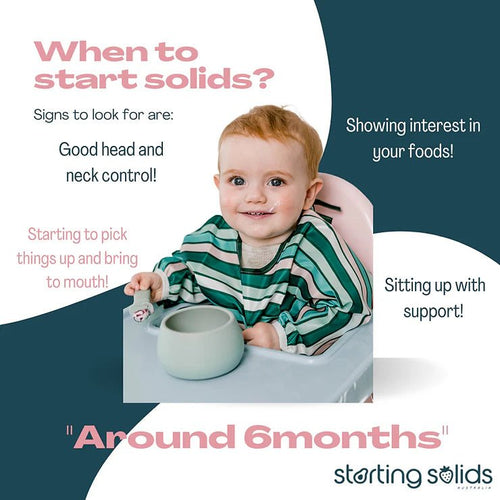
This is exactly why the Australian Infant Feeding Guidelines recommend starting solids at around 6 months, and why iron-rich foods are recommended to be the priority from the very first meals.(1)
Want the full breakdown? Read What's The Deal With Iron For Babies? and All About Zinc.
Iron deficiency isn't rare, and it isn't harmless
This is the part that gets glossed over when we tell parents food is "just for fun".
Iron deficiency is one of the most common nutritional deficiencies in young children. And iron isn't just about avoiding anaemia - it's essential for brain development during a period when the brain is growing faster than at any other point in life. Meeting iron needs in the first year genuinely matters.(1,2)
No one is saying your baby will be harmed if they spit out their first few meals. They won't. But a whole year of treating solids as optional entertainment, with no iron-rich foods in sight? That's a different story.
It's not only about nutrients
Even if we set the nutrition aside for a second, that first year of eating is doing a lot of quiet work:
- Allergy prevention. Introducing the common allergens early - in the first year, and keeping them in the diet regularly - reduces the risk of food allergy developing.(4) You can't do that if food is an afterthought.
- Oral motor skills. Chewing, moving food around the mouth and managing textures are learned skills that need practice and progression.
- Accepting flavours and textures. The window for easy acceptance of new foods doesn't stay open forever.
- Learning to eat with the family. Mealtimes are social, and babies learn by watching us.
Fun? Absolutely. Just for fun? Not quite.
So what should we say instead?
We're not asking anyone to swing the other way and turn mealtimes into a high-pressure performance. Please don't. Pressure backfires, and responsive feeding - following your baby's hunger and fullness cues - is still the goal.
'Food before one is for more than just fun"
In practice, that looks like:
- Start at around 6 months, when your baby is showing the signs of readiness - not by a date on the calendar. (When Should You Start Solids?)
- Make iron-rich foods the priority from day one - meat, chicken, fish, eggs, legumes, tofu and iron-fortified cereals.
- Pair plant sources of iron with a vitamin C food to boost absorption.
- Get the common allergens in early, and keep them in regular rotation.
- Keep it relaxed and responsive. Offer the food; let your baby decide how much.
Milk still matters enormously in the first year. Solids aren't replacing it. They're doing a job milk can no longer do on its own.
Food before one: FAQs
So is "food before one is just for fun" completely wrong?
The sentiment (don't stress about volume) is fine. The implication (solids are optional) is wrong. From around 6 months, solids provide nutrition - especially iron and zinc - that milk alone can't.(1,2)
My baby barely eats anything. Should I panic?
No. Early volumes are genuinely tiny and that's normal. Keep offering iron-rich foods regularly, stay relaxed, and let your baby lead on the amount. If you're worried about growth or intake, speak with your GP or a paediatric dietitian.
Does this mean I should push my baby to eat more?
Definitely not. Pressure and coaxing backfire. Offer the food consistently - the responsibility for how much stays with your baby.
Do I need to stop breastfeeding when solids start?
Not at all. Breastfeeding (or formula) continues right through the first year alongside solids, and breastfeeding can continue well beyond that.(1)
References
- National Health and Medical Research Council (NHMRC) - Infant Feeding Guidelines. Eat For Health, Australian Government. eatforhealth.gov.au
- NHMRC - Nutrient Reference Values for Australia and New Zealand: Iron (RDI 11mg/day for infants 7-12 months; 8mg/day for adult men). eatforhealth.gov.au
- NHMRC - Nutrient Reference Values for Australia and New Zealand: Zinc. eatforhealth.gov.au
- ASCIA - How to Introduce Solid Foods to Babies for Allergy Prevention. Australasian Society of Clinical Immunology and Allergy. allergy.org.au
- World Health Organization - Complementary feeding. who.int
🔒 This is Starting Solids Library content
Unlock every recipe, resource, review & ebook — plus the Crash Course, live monthly workshops, and our members forum.
$25/month unlocks $125+ in value
Unlock Premium AccessAlready a member? Log in