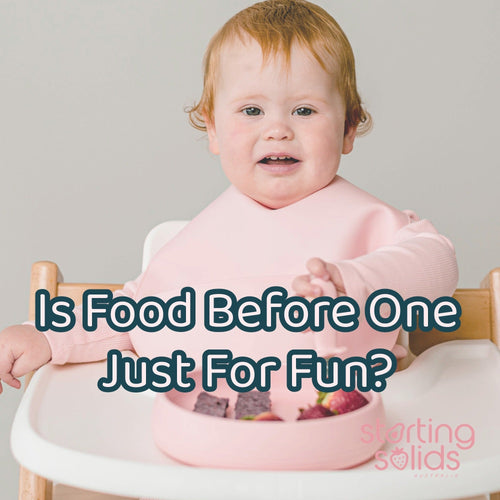
We're not sure how we got here but fruit has somehow become controversial.
The claims: fruit is "just sugar", it'll spike your baby's blood sugar, it creates a sweet tooth, it'll make them refuse vegetables forever - so you must serve vegetables first and ration the fruit.
Many of these claims are very over exaggerated or just plain wrong, and it's making feeding harder for parents when we don't need too. Let's break them down.
"Fruit is just sugar"
Fruit contains sugar. So does breastmilk - lactose, at around 7g per 100ml, which is more sugar per 100g than most whole fruits contain.
The sugar in fruit is intrinsic sugar - locked inside the cell structure of the food, packaged with fibre, water, vitamins, minerals and phytonutrients.
If we look at how the WHO and the Australian guidelines are written: the recommendation to limit sugar is a recommendation to limit free / added sugars. Whole fruit is explicitly excluded.(1,2)
The fibre matrix slows absorption, which is why a whole apple doesn't behave like apple juice, and why apple juice doesn't behave like an apple.
"It'll give them a sweet tooth"
Babies are born preferring sweet. This is well documented - newborns show a clear innate preference for sweet tastes and a rejection of bitter ones, before they've eaten a single thing.(3) It's thought to be protective: breastmilk is sweet, and many toxic plants are bitter.
You didn't cause it. You cannot prevent it. Withholding pear will not make your baby indifferent to sweetness - the preference is already installed.
What actually shapes long-term eating is repeated, low-pressure exposure to a wide variety of foods - including bitter ones like broccoli and kale.(4)
"Vegetables first, or they'll never eat vegetables"
This one at least has real research behind it.
There is some evidence that vegetable-first approaches can improve vegetable acceptance - the research has found modest benefits from starting with and repeatedly exposing babies to vegetables early.(4) So if you want to lead with veg, go ahead. It's a reasonable strategy.
But the claim that offering fruit will ruin vegetable acceptance is a leap the evidence doesn't support. The active ingredient in those studies is repeated exposure to vegetables - not the absence of fruit.
You can do both. Serve the broccoli. Also serve the strawberries. Keep serving the broccoli even when it comes back untouched - babies typically need 8 to 15 exposures before reliably accepting a new food.(4)
Fruit is genuinely doing work
Here's what you're taking away when you ration it:
- Vitamin C - which dramatically boosts absorption of non-haem iron. Serving fruit with an iron-rich meal is one of the most effective things you can do for your baby's iron status.(5)
- Fibre - which matters enormously for the constipation that so often shows up when solids start.
- Energy - babies need a lot, relative to their size.
- Water, potassium, folate and a range of antioxidants.
- Texture and skill practice - soft fruit is one of the best early self-feeding foods there is.
And if your child is going through a phase of refusing vegetables entirely - which happens to almost everyone - fruit covers a lot of the same nutritional ground. Vitamin C, folate, potassium, fibre. It's a genuinely reassuring fact, and it's why we tell parents to take the panic out of the vegetable war.
The things that DO warrant care
Not everything fruit-adjacent is fine...
Juice. This is the real one. Juice removes the fibre and leaves free sugars in liquid form. It's not recommended for babies under 12 months, and should ideally still be limited beyond that.(2) Frequent juice is associated with tooth decay and displaces more nutritious food and drink.
Fruit pouches. Convenient and fine occasionally, but they're a poor substitute for real fruit - sucking puree from a spout teaches almost nothing about eating, and they're often fruit-heavy with little else. Squeeze it onto a spoon or a plate.
Dried fruit. Sticky, concentrated and clings to teeth. Fine occasionally, ideally with a meal rather than as a standalone snack.
Choking Hazards. Whole grapes, cherry tomatoes and blueberries are choking hazards - quarter them lengthways. Hard apple should be grated, cooked, or served in a very thin slice.
The take-home
Whole fruit is so much more than just sugar. It's not creating a sweet tooth that was already there at birth. It's not sabotaging vegetables.
It's fibre, vitamin C, energy and a brilliant early self-feeding food - and it's the thing that makes the iron in your baby's dinner actually get absorbed.
FAQs
Is fruit too sugary for babies?
No. The sugar in whole fruit is intrinsic sugar, packaged with fibre and nutrients. Health guidelines on limiting sugar refer to free sugars and explicitly exclude whole fruit.(1,2)
Will fruit give my baby a sweet tooth?
Babies are born with a preference for sweet tastes.(3) Fruit doesn't create it, and withholding fruit won't remove it.
Should I offer vegetables before fruit?
You can - there's some evidence that early, repeated vegetable exposure helps acceptance.(4) But offering fruit doesn't undo it. Do both.
Can babies have juice?
Not under 12 months, and limited after that.(2) Juice strips the fibre and leaves free sugars in liquid form. Offer whole fruit instead.
How much fruit can a baby have?
There's no magic cap. Just make sure fruit isn't crowding out iron-rich foods - meat, egg, legumes, iron-fortified cereal - which are the real priority at this age.(5)
References
- World Health Organization. Guideline: Sugars intake for adults and children (definition of free sugars). who.int
- NHMRC. Australian Dietary Guidelines and Infant Feeding Guidelines - sugars, fruit and juice. eatforhealth.gov.au
- Mennella JA. Ontogeny of taste preferences: basic biology and implications for health. Am J Clin Nutr. 2014;99(3):704S-11S. PubMed
- Caton SJ, Blundell P, Ahern SM, et al. Learning to eat vegetables in early life: the role of timing, age and individual eating traits. PLoS One. 2014;9(5):e97609. PubMed
- Hurrell R, Egli I. Iron bioavailability and dietary reference values. Am J Clin Nutr. 2010;91(5):1461S-1467S. PubMed